
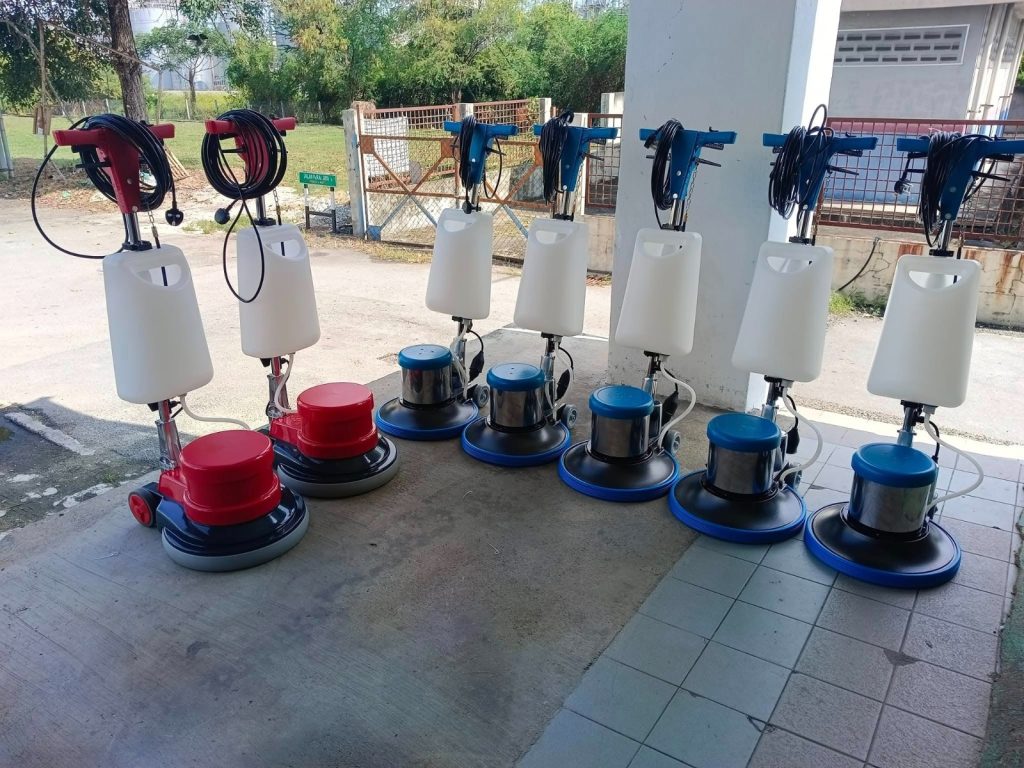
In a world obsessed with speed and automation, there is something quietly impressive about a machine that does not rush. The low-speed rotary scrubber operating at 154 RPM is not flashy, not aggressive, and certainly not loud in its presence. Yet in commercial cleaning environments, it remains one of the most reliable and versatile tools available. Its strength lies not in velocity, but in control. At 154 revolutions per minute, it delivers steady torque, consistent pressure, and dependable surface results that high-speed machines simply cannot replicate.
This machine is often found in facilities management departments, cleaning contractors’ equipment rooms, and maintenance teams responsible for large floor areas. From vinyl tiles to marble, from concrete to epoxy-coated surfaces, the 154 RPM rotary scrubber remains a foundational cleaning solution.
What 154 RPM Really Means in a Low-Speed Rotary Scrubber
The term “154 RPM” refers to the rotation speed of the machine’s pad driver or brush. RPM stands for revolutions per minute, and in this case, the disc rotates 154 times every minute. Compared to high-speed polishers that can spin at 1,000 RPM or more, this is considered low speed.
But lower speed does not mean lower effectiveness. In fact, 154 RPM is deliberately engineered to create stronger downward pressure and higher torque. The machine focuses more on scrubbing and agitation rather than surface gloss. This is why it is commonly used for deep cleaning, stripping, and heavy-duty maintenance rather than polishing.
The controlled rotation reduces the risk of splashing chemicals or damaging sensitive surfaces, making it suitable for both aggressive cleaning tasks and routine maintenance.
The Engineering Behind the Low-Speed Rotary Scrubber (154 RPM)
A low-speed rotary scrubber is built for durability. Most units include a heavy-duty motor, a robust gearbox, and a balanced chassis designed to distribute weight evenly across the cleaning pad. The additional weight actually enhances performance because it increases surface contact pressure.
Key components typically include:
- A powerful motor calibrated to maintain consistent 154 RPM under load
- A pad driver or brush attachment system
- Adjustable handle controls for operator comfort
- Safety switches and overload protection
The slower rotational speed allows the motor to generate higher torque, which is essential for tasks like stripping old wax, scrubbing embedded dirt, or restoring heavily soiled floors.
Applications Where the 154 RPM Rotary Scrubber Excels
The versatility of a low-speed rotary scrubber (154 RPM) is one of its greatest advantages. It is not limited to a single function but instead adapts to various cleaning needs depending on the pad or brush attached.
In commercial and industrial environments, this machine is commonly used for:
- Stripping old floor finish or wax layers
- Deep scrubbing vinyl composition tiles
- Cleaning textured concrete floors
- Carpet bonnet cleaning
- Polishing stone surfaces before high-speed buffing
Because of its torque strength, it can break down stubborn grime that lighter machines struggle with. In facilities such as shopping malls, hospitals, schools, and warehouses, the 154 RPM rotary scrubber is often the first step in floor restoration processes.
Low-Speed Rotary Scrubber (154 RPM) and Floor Stripping Efficiency
Floor stripping is one of the most demanding maintenance tasks. It requires removing built-up layers of old finish without damaging the base material. A low-speed rotary scrubber operating at 154 RPM is particularly effective in this process.
The combination of controlled speed and strong downward force allows the stripping solution to penetrate and loosen the old coating. The rotating pad then agitates and lifts the softened layer. Because the rotation is not excessively fast, operators have better control over chemical distribution and agitation intensity.
This balance reduces the likelihood of uneven stripping and minimises surface scratches.
The Role of Pads and Brushes in a 154 RPM System
The performance of a low-speed rotary scrubber (154 RPM) is heavily influenced by the choice of pad or brush. The machine itself provides torque and movement, but the attachment determines the level of abrasion.
Common pad types include:
- Black pads for heavy stripping
- Red pads for light scrubbing
- White pads for polishing
- Specialised brushes for grout or textured floors
Switching attachments transforms the same machine into a completely different cleaning tool. This adaptability makes the 154 RPM rotary scrubber a cost-effective investment for cleaning contractors and facility managers.
Operator Control and Handling of the Low-Speed Rotary Scrubber (154 RPM)
Operating a low-speed rotary scrubber requires a certain technique. Unlike automatic scrubbers that move forward on their own, rotary machines respond to subtle handle movements. Tilting the handle slightly can shift the machine left or right.
The 154 RPM speed makes the unit manageable for trained operators. Because it does not spin excessively fast, it reduces sudden jerking or aggressive pulling. This controlled behaviour enhances safety, particularly when working in tight spaces or near walls.
With proper training, operators can manoeuvre the machine smoothly across large floor areas with consistent results.
Comparing Low-Speed Rotary Scrubber (154 RPM) with High-Speed Burnishers
It is important not to confuse low-speed rotary scrubbers with high-speed burnishers. Although both are floor machines, they serve different purposes.
A 154 RPM machine is designed for cleaning and stripping. High-speed machines, often operating above 1,000 RPM, are used to create gloss and shine. Attempting to strip floors with a high-speed unit would be inefficient and potentially damaging.
The low-speed model focuses on mechanical agitation rather than surface reflection. In many maintenance programs, both machines are used sequentially: the 154 RPM scrubber prepares the floor, and the burnisher completes the shine.
Durability and Long-Term Value of a 154 RPM Rotary Scrubber
One reason the low-speed rotary scrubber (154 RPM) remains popular is its mechanical simplicity. Compared to fully automated scrubbers with complex electronics, rotary machines have fewer components that can fail.
Their heavy-duty construction means they can withstand demanding environments such as industrial facilities and construction sites. With proper maintenance such as checking cables, cleaning pads, and lubricating moving parts these machines can operate reliably for years.
For cleaning businesses, this longevity translates into strong return on investment.
Safety Considerations When Using a Low-Speed Rotary Scrubber (154 RPM)
While the machine operates at a controlled speed, safety should never be overlooked. Because of its torque strength and weight, improper handling can cause fatigue or strain.
Important safety considerations include:
- Wearing appropriate footwear to prevent slipping
- Ensuring electrical cables are positioned safely
- Avoiding excessive pressure that may stall the motor
- Using correct pads for the intended surface
When used responsibly, the 154 RPM rotary scrubber is a stable and predictable machine, but operator awareness remains essential.
Why 154 RPM Remains an Industry Standard
The specific speed of 154 RPM is not random. It has become an industry standard because it strikes a balance between effective agitation and safe control. Too slow, and cleaning power decreases. Too fast, and surface damage or instability may occur.
Manufacturers have refined this speed over decades of engineering, making it a benchmark for low-speed floor machines. Its reliability across different flooring materials has solidified its role in professional cleaning operations worldwide.
The Enduring Relevance of the Low-Speed Rotary Scrubber (154 RPM)
Technology in cleaning equipment continues to evolve, with robotic scrubbers and battery-powered systems gaining popularity. Yet the low-speed rotary scrubber (154 RPM) remains a cornerstone of professional floor care. Its straightforward design, strong torque, and adaptable functionality make it irreplaceable for deep cleaning and surface preparation tasks.
It may not be the fastest machine on the floor, but it is often the most dependable. In environments where thorough cleaning matters more than speed alone, the steady rotation of 154 RPM continues to deliver consistent, controlled, and powerful results.