
Vinyl Floor Cleaning Singapore: Deep Cleaning, Polishing and Floor Care Guide
Vinyl flooring is widely used in Singapore homes and commercial spaces because it is durable, comfortable underfoot and relatively easy to maintain. However, regular mopping does not always prevent it from becoming dull, sticky or discoloured over time.
Fine dust, body oils, cooking residue, detergent buildup and dirt carried in from outside can settle into the floor’s textured surface. When this happens, repeatedly mopping the floor may move the residue around without extracting it properly.
Professional vinyl floor cleaning in Singapore provides a deeper treatment for floors that no longer respond to routine household cleaning. Depending on the floor’s condition and construction, the process may include machine scrubbing, wet extraction, controlled polishing or the application of a compatible protective coating.
At Dust-Detail, we help homeowners and businesses identify whether their flooring needs deep cleaning, vinyl floor polishing or a more complete restoration process. This guide explains the differences and how to care for vinyl floors without damaging their protective surface.
Why Vinyl Floors Become Dull and Dirty
Vinyl flooring usually has a protective wear layer that resists everyday use. However, dirt can still accumulate on top of this layer, particularly when the flooring has a textured or wood-grain finish.
Common causes of dull vinyl flooring include:
- Detergent residue left behind after mopping
- Using too much floor cleaner
- Dirty mop water being spread across the room
- Cooking oil and airborne grease
- Fine renovation or construction dust
- Perspiration and body oils from bare feet
- Dirt and grit carried indoors on footwear
- Residue from unsuitable shine-enhancing products
- Wear in frequently used pathways
These materials can form a thin film that makes the floor look grey, cloudy or uneven. Dirt may also settle into the small grooves of textured vinyl planks, where a standard flat mop cannot provide enough agitation.
What Is Vinyl Floor Deep Cleaning?
Vinyl floor deep cleaning is a restorative cleaning process designed to remove embedded dirt and residue that routine mopping leaves behind.
Instead of simply spreading cleaning solution across the surface, professional deep cleaning combines an appropriate cleaning agent with controlled mechanical agitation. The loosened residue is then extracted rather than left to dry on the floor.
Our vinyl floor deep cleaning service in Singapore is intended for floors that have become dull, sticky, stained or difficult to maintain through normal mopping.
Deep Cleaning May Be Appropriate When:
- The floor still looks dirty immediately after mopping
- Socks or bare feet become dirty after walking across it
- The surface feels sticky or greasy
- Textured grooves have become darker
- Detergent residue has created a cloudy appearance
- The floor has not been professionally cleaned for a long time
- Renovation dust has settled into the flooring texture
- High-traffic areas look noticeably darker
Deep cleaning cannot reverse every type of damage. Permanent scratches, faded print layers, chemical burns, lifted planks and worn protective layers may require repair, replacement or a suitable restorative coating rather than cleaning alone.
How Professional Vinyl Floor Deep Cleaning Works
The exact cleaning process should be adjusted according to the vinyl type, floor condition and manufacturer’s instructions. A typical professional process may include the following stages.
Floor Inspection
We first inspect the flooring to identify its condition, surface texture and problem areas. We look for embedded dirt, detergent buildup, scratches, stains, loose planks and signs of moisture-related damage.
Customers should tell us about any previous coatings, polishing products or strong cleaning chemicals applied to the floor. This information may affect how the surface responds to professional treatment.
Removal of Loose Dirt
Loose grit, hair and debris should be removed before wet cleaning. If these particles remain on the floor during machine scrubbing, they may contribute to unnecessary abrasion.
Application of a Suitable Cleaning Solution
A floor-compatible cleaning solution is applied in a controlled manner. It may be allowed to remain on the surface briefly so that accumulated oils and residue can loosen.
The product and dilution must be appropriate for the particular flooring. Stronger does not automatically mean better. An unnecessarily harsh chemical can affect the wear layer or leave its own residue.
Controlled Machine Agitation
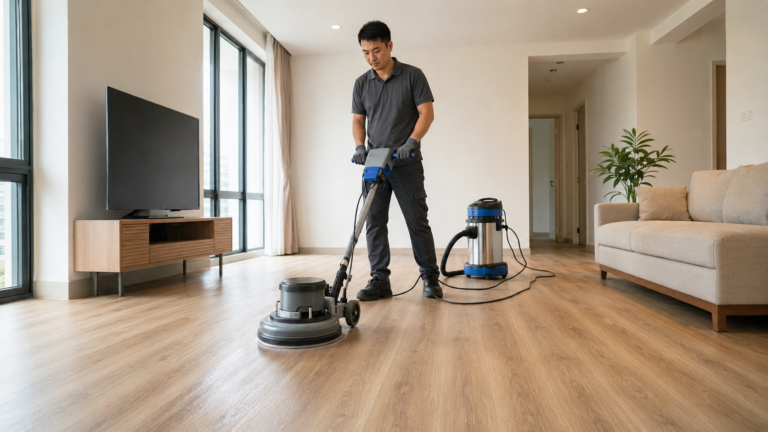
A professional floor machine agitates the surface more consistently than manual mopping. The cleaning pad or brush must be chosen carefully because an overly abrasive pad can scratch or dull vinyl flooring.
Machine agitation helps reach into textured areas and loosen grime from the floor’s surface.
Wet Extraction
After the dirt has been loosened, an industrial wet-vac system extracts the dirty solution. This is a major difference between professional deep cleaning and repeatedly mopping with increasingly dirty water.
You can read more about how industrial wet-vac extraction works and why extracting dirty liquid can produce a cleaner finish.
Rinsing and Final Inspection
The floor may be rinsed to remove remaining cleaning residue before the surface is allowed to dry. We then inspect the result to determine whether additional treatment or a protective coating should be considered.
What Is Vinyl Floor Polishing?
The term “vinyl floor polishing” is used to describe several different processes. This can cause confusion because polishing a vinyl floor is not the same as polishing marble, sanding parquet or applying ordinary household wax.
Depending on the floor, vinyl polishing may involve:
- Mechanical buffing of an existing compatible finish
- Cleaning and refining the appearance of the surface
- Applying a compatible restorative polymer coating
- Maintaining a previously coated commercial vinyl floor
Many modern residential vinyl floors are manufactured with a no-wax wear layer. Applying generic floor wax or an unsuitable polishing product may create a sticky film, trap dirt or make the surface slippery.
For this reason, we inspect the flooring before recommending vinyl floor polishing in Singapore. We must determine what the customer means by polishing and whether the floor is compatible with the proposed treatment.
Deep Cleaning Versus Vinyl Floor Polishing
Deep cleaning and polishing solve different problems.
Deep Cleaning Removes Surface Contamination
Deep cleaning focuses on removing embedded dirt, grease, detergent film and other residue. It is usually the first step when a vinyl floor looks dull because accumulated soil is covering the original finish.
Polishing or Coating Changes the Surface Finish
Polishing, buffing or coating may be considered after the floor has been thoroughly cleaned and assessed. These processes focus on appearance and surface protection rather than simply removing dirt.
If residue remains on the floor, applying a coating over it may trap the contamination beneath the new finish. The floor must therefore be prepared correctly before any compatible protective product is applied.
Some Floors Only Need Deep Cleaning
A floor that looks dull may regain much of its appearance after residue is extracted. In that case, additional polish or coating may not be necessary.
Cleaning should come first. We only consider further treatment after seeing the floor’s actual condition beneath the accumulated dirt.
What Is a Vinyl Protective Coating?
A vinyl protective coating is a compatible surface treatment intended to improve appearance and provide an additional layer over suitable flooring.
Depending on the product and floor condition, a restorative polymer coating may help:
- Create a more even visual finish
- Improve the appearance of dull areas
- Provide an additional sacrificial surface layer
- Make routine maintenance more manageable
- Reduce direct exposure of the original surface to daily traffic
A coating does not repair deep scratches, replace missing material or correct loose planks. Existing damage may remain visible after treatment.
Learn more about our approach to vinyl protective coating and surface restoration.
Can All Vinyl Flooring Be Polished or Coated?
No. Vinyl products differ in construction, wear layer, factory finish and maintenance requirements. A treatment that works on one commercial vinyl floor may not be suitable for a residential luxury vinyl plank.
Factors that affect compatibility include:
- The flooring manufacturer
- Type and thickness of the wear layer
- Existing factory-applied coating
- Previous cleaning and polishing products
- Age and condition of the floor
- Whether the floor is glued down or installed as a floating system
- Presence of damage, lifting or moisture
Where possible, check the manufacturer’s care instructions before authorising a coating. A small test area may also be appropriate when the floor history is unknown.
Why Does My Vinyl Floor Still Look Dirty After Mopping?
This is one of the most common questions homeowners ask us. Several factors may be responsible.
Too Much Detergent
Using extra detergent does not necessarily produce a cleaner floor. If the solution is not rinsed or extracted properly, it can dry into a film that attracts more dirt.
Dirty Mop Water
Once mop water becomes dirty, continuing to use it can spread dissolved soil across the room. Textured sections may collect this dirty liquid as it dries.
An Unclean Mop Head
A mop that contains trapped oil or residue can reapply it to the floor. Wash reusable mop pads thoroughly and replace them when they remain discoloured or greasy after cleaning.
Grease From Cooking
Airborne cooking oils can settle beyond the kitchen. Over time, they form a thin layer that captures dust and makes the floor feel sticky.
Inappropriate Cleaning Products
Oil soaps, waxes and some shine-enhancing cleaners can leave residue on vinyl flooring. A product intended for stone, timber or another surface should not be assumed safe for vinyl.
Embedded Dirt in Textured Flooring
Wood-grain vinyl may contain shallow grooves that cannot be cleaned effectively with a quick pass of a flat mop. Controlled agitation is needed to loosen the compacted dirt.
Safe Routine Maintenance for Vinyl Flooring
Proper household maintenance can slow the return of residue after professional cleaning.
Sweep or Vacuum Regularly
Remove loose grit before it is dragged across the floor. Use a vacuum setting and attachment suitable for hard flooring, without an aggressive rotating brush.
Use a Damp Mop, Not a Soaking-Wet Mop
Vinyl is generally resistant to surface moisture, but excessive water may enter joints, edges or damaged areas. This is particularly relevant for floating vinyl plank systems.
Use a Compatible Cleaner
Follow the flooring manufacturer’s instructions whenever possible. A correctly diluted, neutral cleaner is commonly recommended for routine maintenance.
Flooring manufacturer Tarkett recommends using a damp mop with warm water and a neutral detergent for regular vinyl floor care. You can review its vinyl flooring cleaning and maintenance guidance for general reference.
Change the Water When It Becomes Dirty
For larger rooms, replace the cleaning solution instead of using dark or cloudy mop water across the entire floor.
Clean Spills Promptly
Blot and clean spills before they dry. Avoid flooding plank joints with water while cleaning the affected area.
Use Furniture Protectors
Place suitable felt protectors beneath furniture legs. Replace them when dirt becomes embedded because a contaminated pad can scratch the floor.
Use Entrance Mats
Mats help capture sand and grit before it reaches the flooring. Avoid rubber-backed mats unless the flooring manufacturer confirms compatibility, as some materials may cause discolouration.
Products and Methods to Avoid
Always follow the manufacturer’s instructions for your particular floor. Unless specifically approved, be cautious with:
- Abrasive scouring pads
- Wire brushes or steel wool
- Undiluted bleach
- Strong solvents
- Generic floor wax
- Oil-based soap
- Harsh ammonia-based products
- Excessive water
- Razor blades or metal scrapers
- High-temperature steam cleaning
Steam is sometimes promoted as suitable for every hard floor, but heat and moisture may affect certain vinyl planks, adhesives and joints. Do not use steam unless the flooring manufacturer explicitly permits it.
Can Professional Cleaning Remove Stains From Vinyl?
Some marks are caused by residue sitting on the surface and may improve through deep cleaning. Others involve permanent changes to the wear layer or printed design.
The likelihood of improvement depends on:
- What caused the stain
- How long it has been present
- Whether the surface has been chemically damaged
- Whether the stain has migrated into the vinyl
- Products previously used on the area
- Condition of the wear layer
Cleaning cannot restore printed colour that has faded or been removed. It also cannot completely erase a deep scratch that has cut through the wear layer.
Can Scratched Vinyl Flooring Be Restored?
Light surface marks may become less noticeable after the surrounding dirt and residue are removed. A compatible restorative coating may also improve the overall uniformity of some floors.
However, deep cuts, gouges and missing surface material cannot be cleaned away. Individual plank replacement may be a better option when damage is localised.
Moving heavy furniture without protection is a common cause of scratches. Lift furniture where possible or use suitable moving pads instead of dragging it across the floor.
Vinyl Floor Cleaning for Homes
Residential vinyl flooring is commonly found in bedrooms, living rooms, studies and other dry areas. Dirt patterns often develop along frequently used routes, beside beds, around dining tables and near entrances.
Families may consider professional deep cleaning:
- Before moving into a resale home
- After renovation work
- Before handing over a rental property
- When preparing for a festive gathering
- When routine mopping no longer works
- Before applying a compatible protective coating
Commercial Vinyl Floor Cleaning
Vinyl flooring in offices, shops, clinics, schools and other commercial premises may receive substantially more foot traffic than residential flooring.
Commercial cleaning plans may need to account for:
- Daily foot-traffic levels
- Type of dirt entering the premises
- Operating hours and access restrictions
- Furniture and equipment that must be moved
- Drying time before the area reopens
- Existing floor finish or maintenance programme
Regular maintenance can reduce the need for highly aggressive restorative cleaning later. High-traffic areas may require more frequent attention than rooms with limited use.
Vinyl, Tile and Parquet Floors Require Different Care
It is important to identify the floor correctly before cleaning it. Vinyl, ceramic tiles, natural stone, laminate and parquet can look similar in photographs but require different products and techniques.
Tile floors may tolerate treatment that would damage vinyl. Parquet may require sanding and varnishing rather than wet extraction. Natural stone can also react badly to acidic products.
If you have more than one flooring type, read our guides to professional tile and grout cleaning and restoring dull parquet flooring.
How to Prepare for Vinyl Floor Deep Cleaning
Good preparation allows the technician to focus on the flooring and complete the work more efficiently.
- Remove loose items from the floor
- Move small furniture where possible
- Identify stains and damaged areas
- Tell us about previous coatings or cleaning products
- Secure pets away from the working area
- Provide access to water and electricity
- Plan enough time for the floor to dry
Discuss heavy furniture with us before the appointment. Some items may need to remain in place if moving them could damage the floor or create a safety risk.
Frequently Asked Questions About Vinyl Floor Cleaning
How much does vinyl floor cleaning cost in Singapore?
The cost depends on the floor area, condition, furniture, access and treatment required. Deep cleaning and protective coating are separate processes, so photographs and floor measurements are useful when requesting a quotation.
How long does vinyl floor deep cleaning take?
The required time depends on the size of the area, degree of soil buildup and number of items that need to be moved. Larger or heavily soiled floors require more time for agitation, extraction and rinsing.
Can deep cleaning make my vinyl floor look new again?
Deep cleaning can significantly improve a floor covered by embedded dirt or residue. It cannot reverse permanent fading, deep scratches, damaged planks or a worn-through surface layer.
Is vinyl floor polishing the same as waxing?
No. Polishing may refer to controlled buffing or the use of a compatible floor finish. Generic wax should not be applied unless the particular flooring and manufacturer permit it.
Can you polish luxury vinyl planks?
It depends on the product and its factory finish. Many modern luxury vinyl planks are designed as no-wax floors. We inspect the flooring and consider the manufacturer’s care instructions before recommending any treatment.
Why does my floor feel sticky after mopping?
Sticky flooring is commonly caused by excessive detergent, incomplete rinsing, cooking residue or incompatible cleaning products. Professional deep cleaning may help if the stickiness is caused by removable residue.
Can you remove renovation dust from vinyl flooring?
Deep cleaning may remove renovation dust trapped in textured surfaces. However, paint, adhesive, cement residue and chemical damage may require separate assessment. Aggressive scraping should be avoided.
Can a steam mop be used on vinyl flooring?
Only use steam if the manufacturer explicitly confirms that it is safe for the exact product. Heat and moisture may affect some planks, joints and adhesives.
How often should vinyl floors be professionally cleaned?
There is no fixed schedule for every property. Professional cleaning may be considered when routine maintenance no longer removes residue or when the flooring becomes dull, sticky or uneven. Commercial premises may require more frequent treatment.
Do I need to leave the property during cleaning?
This depends on the size and layout of the working area. Occupants should stay away from wet sections and allow the flooring to dry before walking on it.
Can protective coating hide scratches?
A suitable coating may make light surface marks less noticeable by creating a more uniform finish. It will not fill deep scratches or replace missing surface material.
Should I replace or deep-clean my vinyl floor?
Deep cleaning is worth considering when the problem is embedded dirt, grease or detergent residue. Replacement may be more appropriate when planks are lifting, deeply damaged, badly faded or affected by underlying moisture.
Book Vinyl Floor Cleaning in Singapore
If regular mopping no longer restores your vinyl flooring, the problem may be embedded dirt or cleaning-product residue rather than permanent damage.
At Dust-Detail, we use professional equipment to agitate and extract accumulated grime from vinyl floors. After deep cleaning, we can assess whether the floor would benefit from a compatible polishing or protective-coating process.
Send us clear photographs of the flooring, the approximate floor area and details of any previous treatments. We will help you determine whether you need vinyl floor deep cleaning, vinyl floor polishing or a more complete restoration service.
Contact Dust-Detail at +65 8057 3729 to request a quotation for professional vinyl floor cleaning in Singapore.